Offshore gear has been refined for decades but never truly reinvented. Here's the thinking behind a fishing platform that throws out the rod entirely.
Walk down the aisle of any tackle shop and you will see hundreds of rods. Different lengths, different actions, different price points — but fundamentally the same tool that anglers have been using for well over a century. The rod-and-reel has been polished to a mirror shine, yet its basic shape has barely changed. We looked at that and asked a question that sounds almost heretical in fishing circles: what if the rod itself is the bottleneck?
Sling Reel did not begin as an attempt to build a better rod. It began with a blank sheet of paper and a simple goal — design the most capable offshore fishing platform possible, with no obligation to honor the conventions of gear designed for a different era. The result is a rod-less system, and this is the thinking behind it.
The quiet limits of the rod
A fishing rod is, at its core, a spring. You load energy into the blank on the cast and let it unload to send the bait. You lean on its flex during the fight to cushion runs and protect the line. It is an elegant solution, and for inshore fishing it works beautifully.
Offshore is a harsher arena. Anglers there consistently run into the same walls: casting distance tops out, control fades during long battles with powerful fish, and the gear is long, awkward, and fragile in transit. Rods bend and break at the worst possible moments. And there has never been a reliable, built-in way to measure and prove a record catch in the moment it happens. For decades, serious anglers have simply adapted to these limitations and called them the cost of doing business.
We did not want to adapt to them. We wanted to remove them.
A platform, not an upgrade
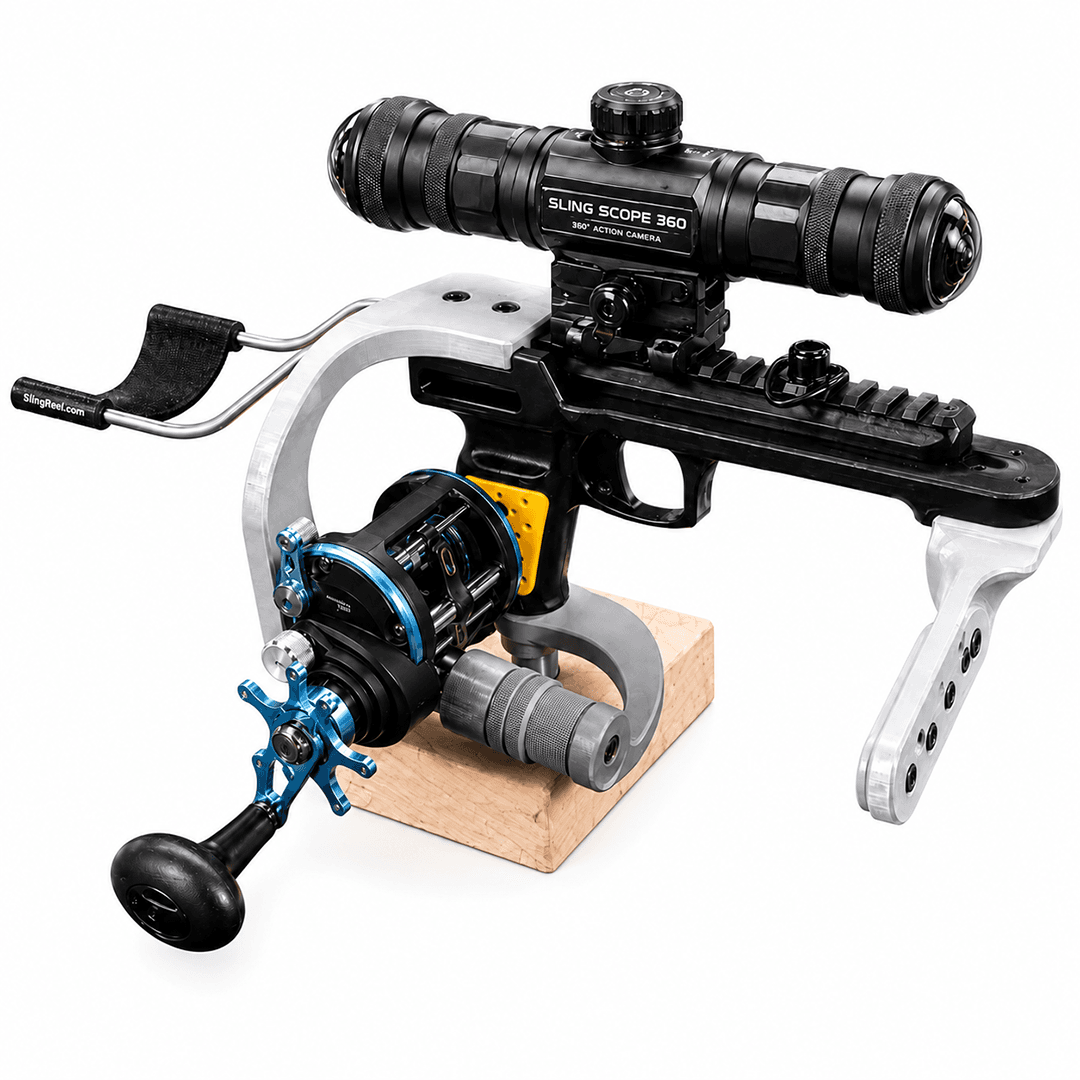
The Sling Reel is best understood not as a reel, and certainly not as a rod, but as a platform. The granted patent describes it as three integrated assemblies working together: a gun assembly that the angler holds and aims, a frame assembly that braces against the body to transfer leverage, and the fishing reel itself, which mounts to the frame and stores the line.
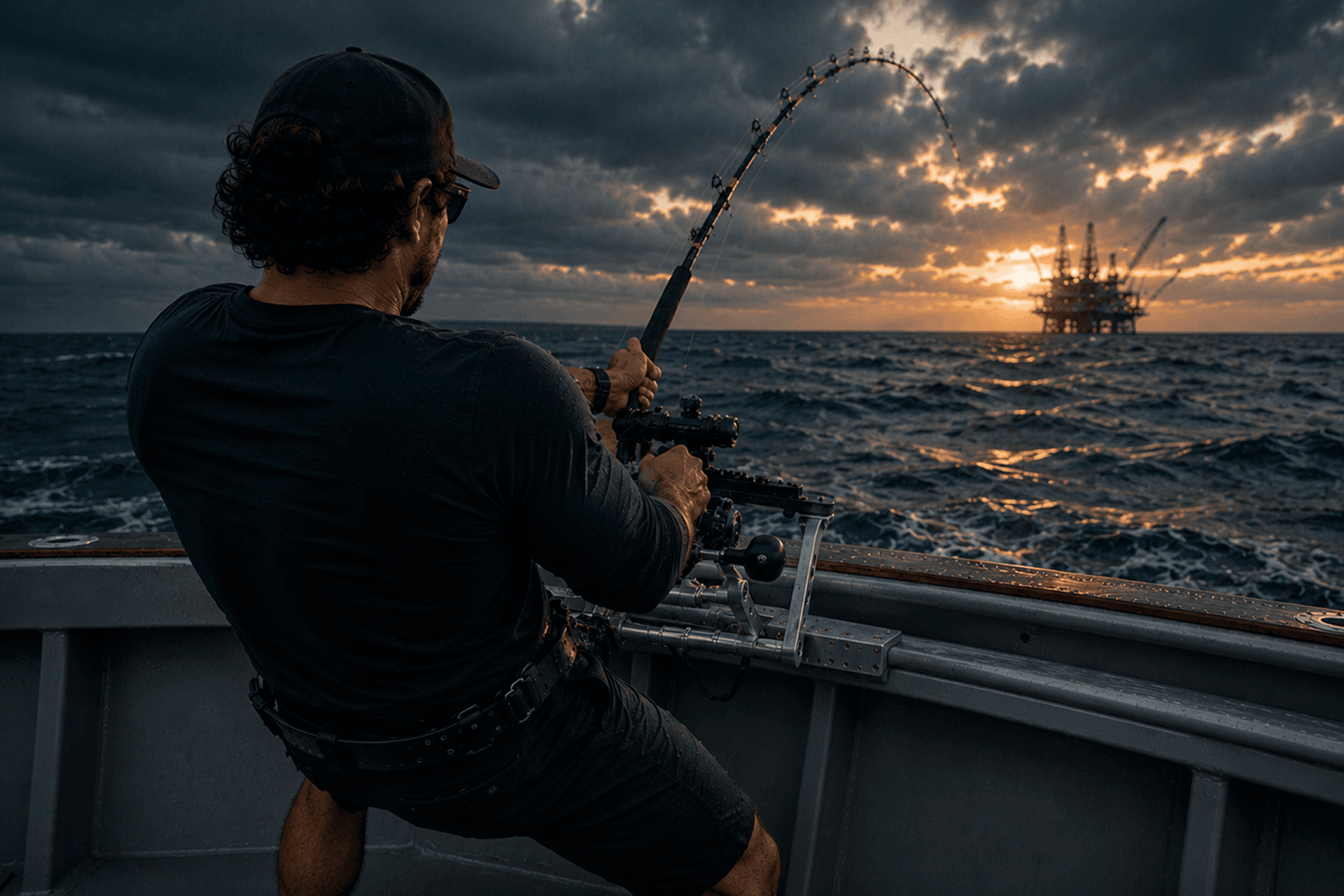
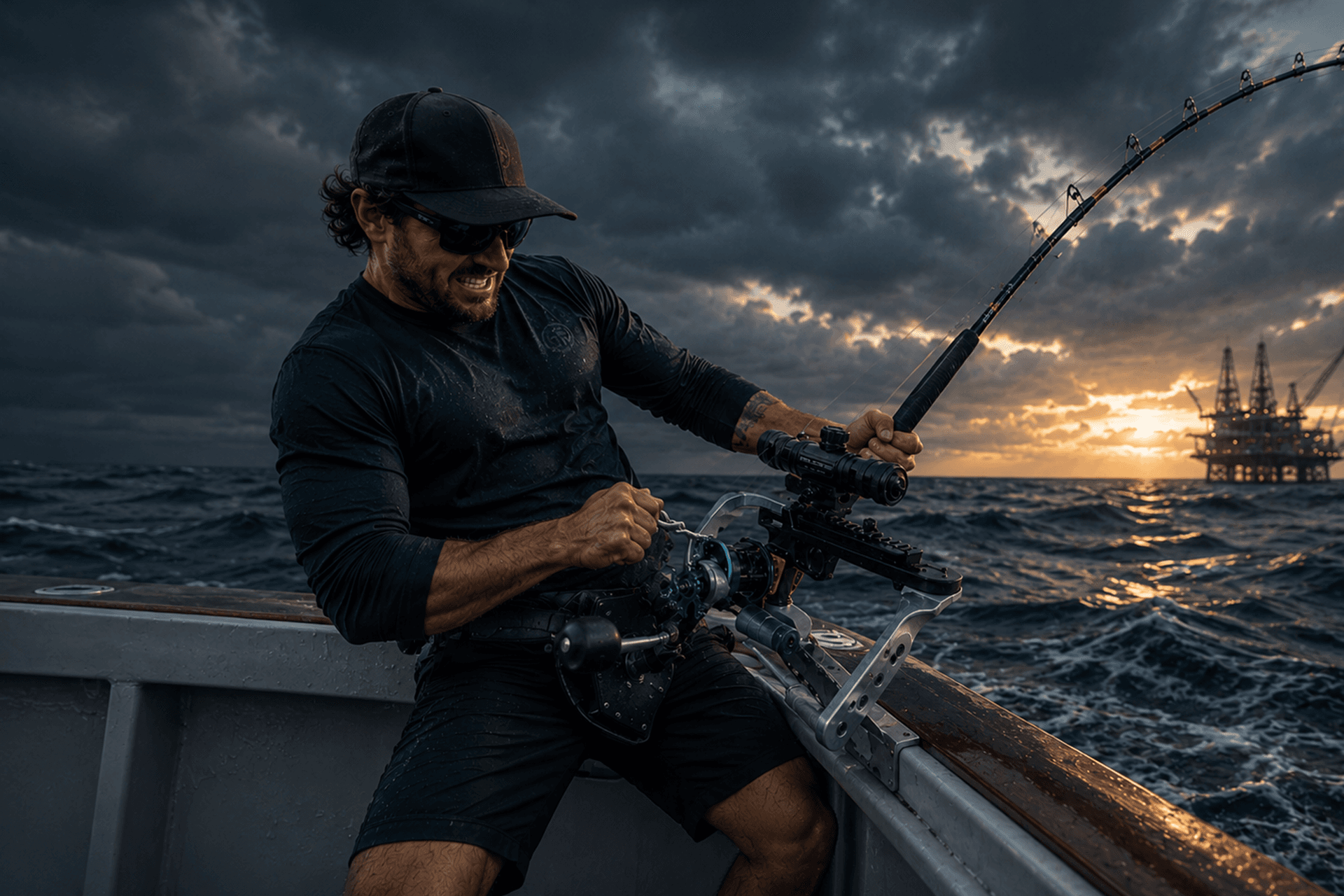
That architecture changes the relationship between the angler and the fish. Instead of relying on a long lever that flexes and fatigues, the system puts casting power, aiming, and fighting control directly into the angler's hands and against their frame. It is a more direct, more stable, and more repeatable way to fish.
Casting, reimagined
Casting with the Sling Reel feels different because it is different. The gun assembly — with its line guide, faux trigger, trigger guard, and thumb-rest slot — is built to be pointed and released with intention. There is a Picatinny rail and an adjustable D-ring, so the platform can be configured and sighted to the angler's preference.
The payoff is reach. Freed from the mechanical limits of a flexing blank, the platform is engineered to deliver greater casting distance and more precise targeting — putting bait and lures on fish and structure that would otherwise sit beyond range.
Winning the fight
Distance is only half the story. The other half is what happens after the hookset. The frame assembly — upper and lower lateral supports, a handle rod, a rod butt gimbal, and an arm support — is designed to brace the platform against the angler's body, transferring the load of a big fish into a stable structure rather than into tired wrists and forearms.
The result is improved leverage and control through long fights with powerful offshore species. You stay in command of the fish for longer, with less fatigue, which is exactly what you want when a trophy is on the other end of the line.
Built to travel, built to last
One of the most underrated advantages of going rod-less is logistics. Without a long blank to transport, the system is volumetrically efficient — it packs down for carrying, transport, and storage. For anglers who fly to fish or run small boats far offshore, that is not a minor convenience; it changes what is practical.
Just as importantly, the platform assembles and disassembles without any special tools, and it is engineered for durable, reliable construction in demanding saltwater conditions. Easy to break down, easy to rebuild, and built to keep working trip after trip.
Protected, and genuinely new
When we say this is a new category, we mean it in the most literal sense. The platform is protected by a granted United States patent, US 12,610,931 B1 — “Sling Fishing Reel.” The patent record notes that the applicant is aware of no existing fishing reel with these novel features. That is rare, and it is the foundation everything else is built on.
A rod-less reel is not a gimmick or a styling exercise. It is the answer we arrived at when we let go of assumptions and engineered around the realities of modern offshore fishing. The rod served anglers well for a long time. We think the next chapter looks different — and we built it.